Foaming-agent formulation license
Technology transfer for selected foaming-agent formulations, handling guidance, and agreed quality-control procedures.
Technology Transfer & Licensing
License foaming-agent chemistry and establish local foaming-equipment manufacturing capability for lightweight cellular concrete production. A transfer scope can join formulation guidance, generator setup, operating procedures, quality checks, and team training in one documented program.
Request a Technology Discussion
Transfer Program
A project scope can be tailored to the licensee's market, available raw materials, manufacturing capacity, and target applications.
Technology transfer for selected foaming-agent formulations, handling guidance, and agreed quality-control procedures.
Equipment architecture, manufacturing documentation, assembly workflow, and commissioning support for foaming generators.
Practical training for solution preparation, foam generation, mixing sequence, production checks, and troubleshooting.
Adaptation of the transferred process for lightweight cellular concrete casting, including coordination with SIP formwork systems.
Foaming Generator Engineering
A generator system typically combines a foam-solution supply, water circuit, compressed-air connection, foam-generation chamber, controls, and delivery hose. The exact arrangement, capacities, and operating envelope depend on the chosen equipment and must be confirmed from its technical data and commissioning tests.

Where provided, metering and control valves help operators adjust the solution and air inputs within the machine's approved range. Foam density should be verified with a repeatable sampling method; valve position alone is not a substitute for measurement.
A continuous arrangement can supply foam in a steady flow to a compatible mixing process when feed rates and downstream demand are matched. A batch workflow makes a defined quantity, allowing checks between runs and straightforward reconciliation of material use. Confirm which mode the selected generator supports; neither mode should be assumed without equipment specifications.
The production brief should state target output, shift duration, changeovers, allowable downtime, and how foam quality will be sampled. These inputs inform equipment sizing, storage and staging needs, operator allocation, and the commissioning plan.
An installation plan locates the air compressor, water pump, solution tank, filters, isolation valves, hoses, power supply and safe access for cleaning. Pressure and flow requirements are taken from the selected generator documentation, then confirmed against the site utilities under operating conditions.
For heavy-duty site use, assess the frame, corrosion protection, guards, connectors, serviceability, transport method, and environmental exposure. Durability is a configuration and maintenance outcome, not a generic performance guarantee.

The utility photograph identifies the water-pump and compressed-air interfaces, service access and isolation points. Record actual site pressure and flow readings during commissioning for later troubleshooting.
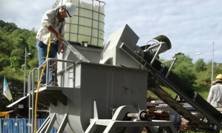
Show the generator positioned for stable operation, protected hose routing, clear operator access, and proximity to the mixing point. A documented cleaning and inspection routine helps preserve reliable performance across demanding site shifts.
A representative sample can be used to record foam density, appearance, drainage, and stability under a defined test procedure. Compare results against project acceptance criteria before incorporating foam into a production mix.
Foaming-Agent Technology
Foaming-agent performance is influenced by product chemistry, dilution water, generator settings, cement and sand characteristics, mixing energy, temperature, and the time between foam generation and placement. These variables should be evaluated together through controlled trial batches rather than treated as independent guarantees.
Record product identity, storage conditions, batch number, and water quality during preparation. Follow the supplier's current technical data and safety instructions for handling and dilution.
A target foam should be assessed for density, drainage, bubble distribution, and stability under the intended mixing and placement sequence. A uniform cellular structure is a design objective that must be verified in fresh mix and hardened-product testing.
Evaluate the formulation with the actual cement, sand grading, water, and any approved admixtures planned for production. Mixing order and energy should be controlled so the foam is incorporated without unnecessary collapse or segregation.
Use the product's approved dilution range as a starting point, then confirm foam quality and concrete performance through trials. Calculate concentrate cost per cubic metre from actual dilution, measured consumption, production yield, losses, and local prices; do not assume one ratio or cost applies to every generator and mix.
Cellular concrete can be specified to investigate reduced heat transfer and sound transmission compared with denser alternatives, subject to density, thickness, moisture, and assembly design. Quantified insulation claims require test data for the finished product or wall assembly and should not be inferred from foam appearance alone.
We will review your market, target products, and local production plan.
Start a ConversationTechnical Process
Every project is scoped around the same inputs: intended use, target output, local material sources, available utilities and acceptance criteria. Formulation, foam generation, mixing, transfer, placement and inspection are planned as one workflow, not as separate operations.
No dilution ratio or cement-to-sand ratio can be fixed in advance. The recipe is established from product data, the mix design and the materials on site, then qualified through trial mixes before production release. A generator delivers steady foam only inside its verified operating envelope, with output matched to mixing and placement; capacity, pressure and flow are confirmed with equipment data and commissioning measurements. Pump and hose performance follow the mix, the route, the lift and the rate of placement.
Foam density, fresh concrete density, workability, material consumption and interruptions are recorded on a repeatable sampling plan. Placed material is protected, and curing, demoulding, loading and follow-on trades follow approved project criteria and strength evidence; curing time varies with formulation, geometry, temperature and humidity. In SIP assemblies the formwork is never removed, so the wall arrives already formed and insulated, with any insulation or cladding contribution designed and verified for that assembly.
Prepare and measure solution
Follow formulation-specific handling guidance; record concentrate lot, dilution water, and measured quantities.
Stabilize generator output
Confirm rated output and utility limits; verify foam density by sampling instead of relying on valve position.
Integrate downstream equipment
Coordinate compressor, water pump, mixing capacity, hose route, and placement demand during commissioning.